Contents
ABP (Activation By Personalization)
ADR (Adaptive Data Rate)
CRC (Cyclic Redundancy Check)
EIRP (Effective Isotropic Radiated Power)
OTAA (Over The Air Activation)
Activation
Before an end device can send and receive messages, it must be registered with a network, this process is called activation. There are two ways to activate a device: Over-the-Air Activation (OTAA), which is the most secure and flexible, and Activation-by-Personalization (ABP), which is less secure and flexible.
ABP (Activation By Personalization)
The ABP method of activation is a less secure method of device activation, where you have to manually program matching keys into both the device and the network. To switch networks, you need to physically access the device to reprogram the keys.
ADR (Adaptive Data Rate)
Adaptive Data Rate (ADR) adjusts the spreading factor, bandwidth and transmission power settings of a device to help optimize data rates, airtime, and energy use in the network.
ADR also helps save device power while making sure gateways still receive messages. When using ADR, the network server tells the device to lower transmission power or increase data rate. Devices near gateways should use a lower spreading factor and higher data rate, while devices farther away should use a higher spreading factor for a stronger signal.
Application Server
The application server handles data messages from end devices and creates application-layer downlink messages to send back through the network server. A LoRaWAN network can have multiple application servers.
Bandwidth
Bandwidth is the range of frequencies used by a radio signal, measured in Hertz (Hz). It affects transmission time and receiver sensitivity. A higher bandwidth shortens transmission time and lowers power use but reduces receiver sensitivity.
Coding Rate
The coding rate shows the proportion of bits that carry information in a payload. For example, a 4/5 coding rate means 4 bits carry information and 1 bit is for error correction, making a total of 5 bits. LoRa uses these Coding Rates:
- CR1: 4/5 (1 error correction bit, 4 information bits)
- CR2: 4/6 (2 error correction bits, 4 information bits)
- CR3: 4/7 (3 error correction bits, 4 information bits)
- CR4: 4/8 (4 error correction bits, 4 information bits)
CRC (Cyclic Redundancy Check)
A Cyclic Redundancy Check (CRC) is a robust error-detecting code commonly used in digital communications and storage to verify data integrity. It helps ensure reliable communication by identifying changes to raw data during transmission, especially over noisy channels.
dB (Decibel)
The decibel (dB) is a unit used to measure the ratio between two values on a logarithmic scale. In radio transmission, it’s commonly used to describe antenna gain relative to a fixed reference point and the signal-to-noise ratio.
dBm (Decibel-milliwatts)
dBm (decibel-milliwatts) is a unit used to show that a power level is expressed in decibels (dB) relative to 1 milliwatt (mW). Although not an official SI unit, dBm is very useful for setting standards.
Device Classes
The LoRaWAN specification defines three classes of devices:
- Class A: Devices that open receive windows right after sending an uplink message.
- Class B: Devices that add extra periodic receive windows.
- Class C: Devices that are always listening for downlink messages.
All LoRaWAN devices must support Class A. Class B and Class C are optional features added to Class A devices.
Downlink Message
A downlink message is a message sent from the network server to a device through a gateway. It allows you to update or configure the device remotely, such as adjusting the uplink interval. Downlinks can also include firmware or security updates for the device.
EIRP (Effective Isotropic Radiated Power)
The Effective Isotropic Radiated Power (EIRP) is the total power radiated by an antenna in one direction shown in dBm or Watts. The maximum allowed EIRP varies by region.
End Node
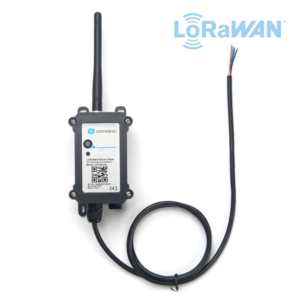
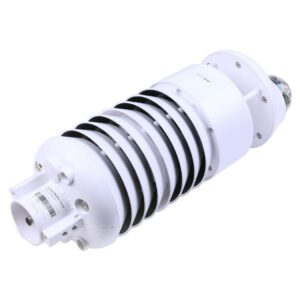
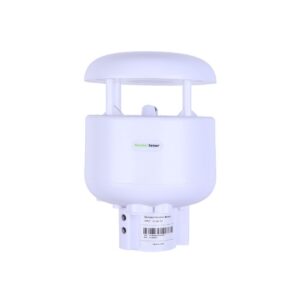
An End Node is a sensor or actuator that connects wirelessly to the LoRaWAN network.
Forward Error Correction
Forward error correction controls errors in noisy data transmission by adding extra redundant data. The receiver uses this data to check if the information is correct and only accepts data that appears to be accurate.
Frequency
The frequency of a radio wave is the number of times it oscillates per second, measured in hertz (Hz). The radio spectrum ranges from 30 Hz to 300 GHz. To avoid interference, the transmission of radio waves is strictly regulated by national laws.
Frequency Plan
A frequency plan sets the data rates and channels for a specific region according to LoRaWAN regulations. Devices are set up with a frequency plan when activated and can use any plan within their supported band.
Gateway
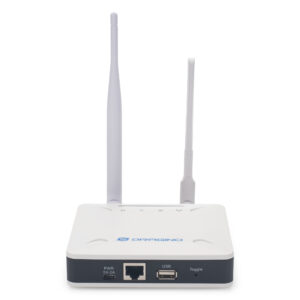
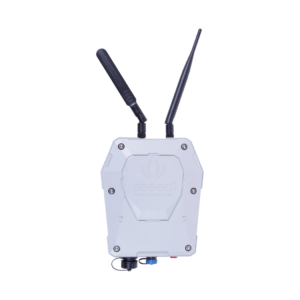
An IoT Gateway is a device that receives and transmits information, acting as the connection point between the cloud and controllers, equipment, systems as well as sensors and other intelligent IoT devices. All the data which is transmitted to and from the cloud goes through a gateway. They can also provide security as they control the flow of information in both directions.
Join Server
The Join Server handles join-request messages from end devices. It stores root keys, creates session keys, and sends these keys to the network server and application server. The Join Server was introduced in LoRaWAN versions 1.1 and 1.0.4.
LoRa
LoRa is a wireless technology that uses chirp pulses to send information through radio waves, kind of like how dolphins and bats communicate. This technique of encoding data is known as chirp spread spectrum technology.
LoRaWAN
LoRaWAN is a software layer (known as a Media Access Control (MAC) layer protocol) that tells devices how to use the LoRa hardware. It controls things like when devices send messages and how those messages are formatted. The LoRa Alliance creates and updates the LoRaWAN protocol.

LPWAN
LPWAN is the term for a low-power wide-area network. It is a wireless wide-area network designed to facilitate long-range communications. With a typical data range of 0.3kbit/s to 50kbit/s per channel, it is ideal for users seeking to run a low-power and low-bit rate system.
NB-IoT
NarrowBand IoT (NB-IoT) is a low-power wide-area network (LPWAN) technology developed by 3GPP that enables a wide range of cellular devices and services. Like LoRaWAN, NB-IoT is optimized for low costs, long battery life, and a high connection density.

Network Server
The Network Server runs the LoRaWAN network. It receives and sends messages to gateways to be routed to end devices. It also handles things like activation, making sure messages aren’t repeated, confirming message receipts, geolocation, and adjusting ADR.
Noise Floor
The noise floor is the sum of all noise sources in a system. It is typically the size of the smallest unit that can be measured by the system. LoRa and similar technologies can find signals even if they are below this noise floor by spreading the information across a wide range of frequencies.
OTAA (Over The Air Activation)
This is the most secure way to activate devices. The device goes through a join procedure with the network, where it gets a temporary device address, and security keys are exchanged.
Packet Forwarder
A Packet Forwarder is software on a gateway that handles LoRa packets, sending them to and from a Network Server. There are two main types: the Semtech UDP packet forwarder and the newer LoRa Basics Station packet forwarder. The UDP packet forwarder is more common but uses unsecured packets. The LoRa Basics Station offers better security with features like updates, TLS authentication, and central management of frequencies.
Preamble
The preamble is a series of chirps that help the receiver detect a LoRa packet. LoRaWAN uses 8 chirps as the preamble.
RSSI (Received Signal Strength Indicator)
The RSSI is the received signal power in milliwatts (measured in dBm) which is used as a measurement of how well the signal is received.
SNR (Signal to Noise Ratio)
The SNR shows the ratio between the received power signal (RSSI) and the noise floor power level expressed in dB.
Spreading Factor
The spreading factor defines the spreading pattern applied to the data before modulation. It controls both the chirp rate and therefore the data transmission rate. LoRaWAN defines 6 spreading factors from SF7 to SF12.
Time On Air
Time On Air is the time a transmitter is on/the time it takes for it to complete a transmission. In LoRa, this includes the preamble and payload durations. The spreading factor and coding rate affect how long it takes to send data and how much data a device can send.
Uplink Message
An uplink message is a message sent from an end device to the network server and is passed through one or more gateways.